Why CPOs are quietly losing their best customers — and it isn't about pricing
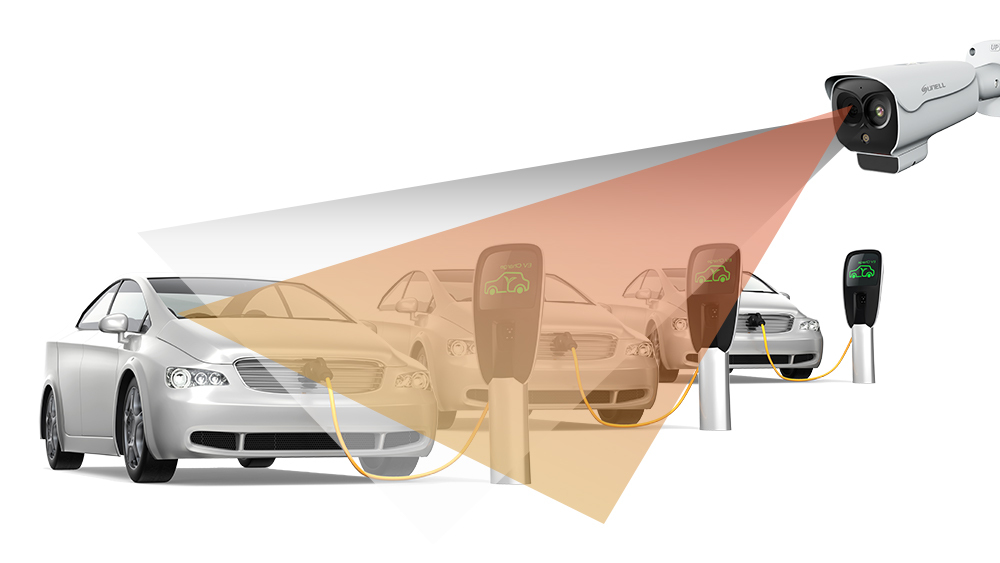
A driver pulls into your site, plugs in, and... nothing. The session won't start. Or it starts and drops mid-charge. They wait a few minutes, try another connector, maybe call a support number that puts them on hold. Eventually they give up, drive to a competitor's network, and — this is the part that should worry every CPO — they don't come back.
That's not a one-off bad review. That's the CPO growth model breaking in real time.
Your business is built on repeat drivers, not one-time transactions
Charge Point Operators don't grow by winning a driver once. The entire unit economics of a charging network — utilization, revenue per site, payback period on capex — depends on drivers coming back to the same network again and again. A driver who trusts your network charges there by default. A driver who's been burned once starts checking three apps before they commit to a site, and eventually stops checking yours at all.
So when a session fails to initiate or complete, the CPO doesn't just lose the revenue from that one session. It loses the thing the entire business model is built on: a repeatable customer.
What's actually happening when a session fails
Charging failures are rarely a single dramatic event. More often it's something physical and mundane at the site itself, and it falls into a handful of recurring patterns:
- A blocked bay. An ICE vehicle is parked in the charging slot — not charging, just sitting there — and every EV that pulls up has to leave without a charge.
- A dirty or obstructed bay. Garbage or debris has accumulated at the slot, making it unusable or simply unwelcoming enough that drivers turn away.
- Cable theft. Burglars make a swift, opportunistic cut-and-run on the charging cable — often in minutes, often at night or in low-traffic hours — leaving the bay dead until someone notices.
- Vandalism. Damage to the touchscreen, the charger housing, or the power electronics, sometimes petty, sometimes targeted — either way, the unit is out of service until it's inspected and repaired.
- Hardware and connection faults. A cut or damaged cable from wear rather than theft, a stuck connector, a card reader fault, a driver who can't get the handshake to complete.
Individually, each of these is a small, local incident. Collectively, they're the difference between a site that drivers trust and one they quietly stop visiting.
What all five have in common is that none of them require the driver to report anything for the CPO to know. They're all visible — to a camera, if something is actually watching for them. The problem isn't that these things happen — hardware and human behavior in the field always create friction. The problem is how long it takes anyone to know about it, and how long it takes the right person to act.
Why a ticketing system doesn't solve this
The instinct is often to bolt on a support tool — a Zendesk-style helpdesk, a ticket queue, an inbox someone monitors.
That's the wrong category of tool for this problem, and it's worth being precise about why.
Ticketing systems were built for BPO and customer-service operations: a person has a problem, a person reports it, another person triages and routes it. The workflow starts with a human complaint. It's fundamentally reactive, and it manages conversations — not physical infrastructure.
A CPO network is not a conversation-management problem. It's a distributed fleet of unattended physical assets, spread across hundreds of sites, that need to be monitored, maintained, and kept in service against uptime and safety commitments. That's an asset lifecycle management problem — the discipline that EAM and CMMS systems exist for: continuous condition monitoring, automatic fault detection, work orders tied to a specific asset and SLA, and a full maintenance history you can audit.
A ticket tells you someone was unhappy. An EAM/CMMS-grounded system tells you which charger, what failed, since when, who's fixing it, and whether it was fixed inside the SLA. Only one of those protects driver trust — and only one of those is a defensible operating discipline for a business built on retention.
The Energos.ai approach: turn your existing CCTV into a proactive layer
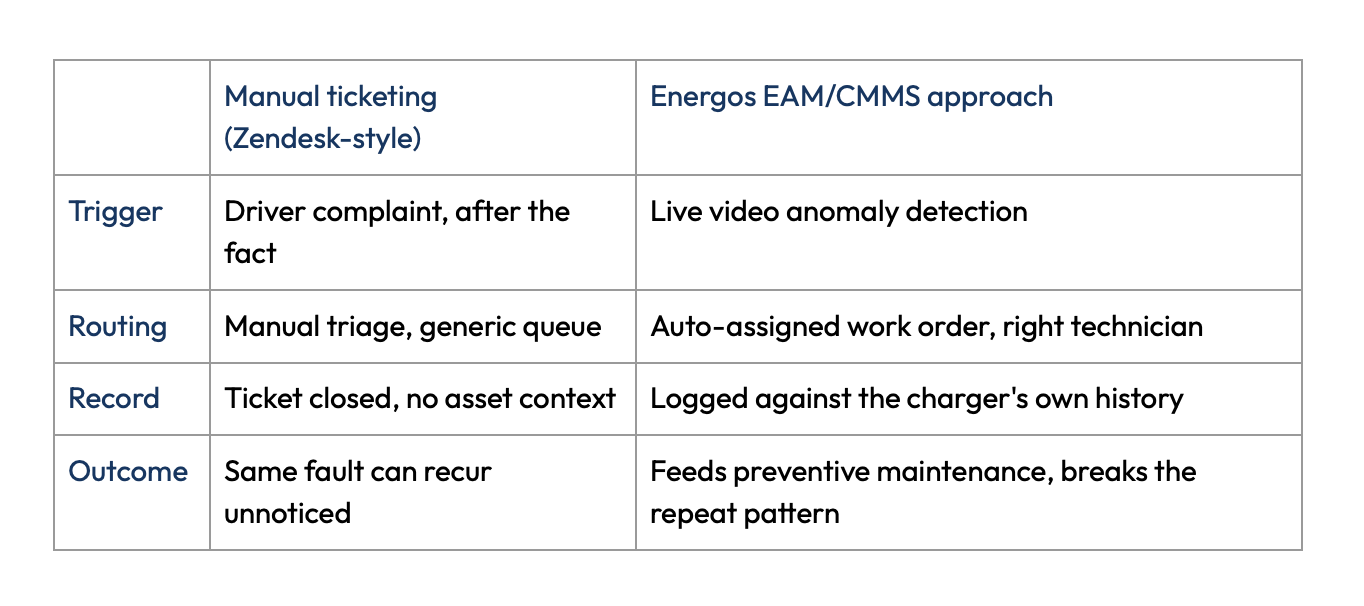
Here's the part CPOs usually assume requires new hardware, sensors, or a rip-and-replace of their site infrastructure. It doesn't.
Energos.ai runs video analytics on top of the CCTV cameras you already have installed at your sites. No new hardware, no new wiring, no site visits required to deploy. The cameras that are already watching your charging bays for security become a live detection layer for operational events.
The moment something goes wrong at a bay — an ICE vehicle occupying the slot, debris piling up, a cable being cut, vandalism to the touchscreen or power electronics, a connector fault, a driver stuck mid-session — the system:
- Detects the event directly from the existing video feed, in near real time.
- Sends a timely alert to the site host on the ground and the remote operations team simultaneously, so no one is waiting on the other to notice.
- Automatically generates a work order if field dispatch is required, and assigns it to the right personnel — no manual entry, no one has to remember to log it, no delay while someone decides who owns it.
That third step is the one most solutions skip, and it's the one that actually matters operationally. An alert that lands in an inbox is only as good as the person who reads it, prioritizes it, and remembers to follow up. An automatic work order removes that human dependency — the moment matters most.
Walking through it: a cable cut incident
Imagine this scenario — a charging cable gets cut or damaged at a bay.
Without proactive detection: the fault sits invisible until a driver plugs in and it fails, or until routine maintenance rounds happen to catch it — which could be days later. Meanwhile every driver who tries that bay has a failed session, and some percentage of them never come back.
With Energos.ai: the video analytics layer flags the cable cut as soon as it happens — often before a driver ever gets to it. The site host gets an alert to check the bay and take it offline if needed. The remote team gets the same alert, with full visibility, so they can track it centrally. A work order is generated automatically and routed to the right field technician, with the SLA clock already running. The bay is fixed and back in service — and, critically, no driver ever hits that dead connector at all.
The same loop applies whether the event is an ICE vehicle sitting in the slot, debris piling up, or vandalism to the touchscreen or power electronics — the detection trigger changes, the response loop doesn't. That consistency is what makes it operationally sustainable across hundreds of sites rather than a one-off fix for one type of incident.
Why "automatic" is the operative word
Timely detection using infrastructure you already own, paired with alerting the right people both on-site and remotely, closes the loop between something went wrong and someone is fixing it. But the step that protects your KPIs is automation of the work order and assignment itself.
Manual hand-offs are where things get lost — an alert seen but not actioned, a message that sits in someone's inbox over a weekend, a technician who wasn't told which bay or what the fault was. Every one of those gaps shows up later as a missed SLA, an under-reported downtime metric, or a driver who walked away and didn't tell you why.
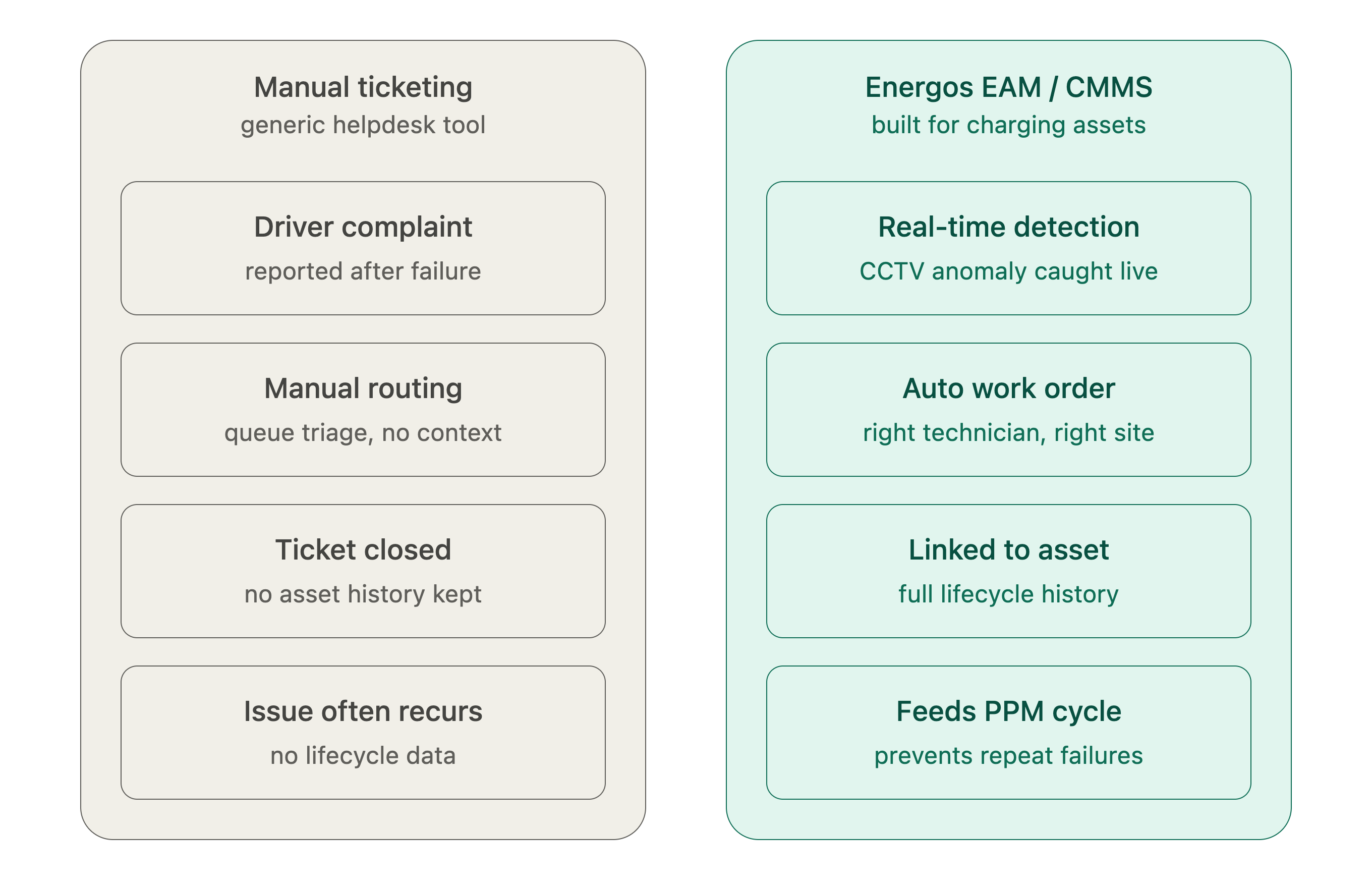
Automatic work orders mean the right person is assigned the moment the fault is confirmed, the SLA clock starts immediately, and nothing depends on someone remembering to escalate. That's what keeps meantime-to-repair honest, keeps uptime commitments to your own clients or investors defensible, and keeps the story consistent from detection to resolution.
The business case, in one line
Driver loyalty is won or lost at the moment a session fails — and that moment is almost always invisible to the CPO until it's too late to do anything about it. Energos.ai closes that gap using cameras you already have, turning silent hardware failures into detected events, timely alerts, and automatically dispatched work orders — before a driver has to be the one who tells you something's wrong.
See it on your own sites
If your team is fielding driver complaints that trace back to charger faults nobody caught in time, this is worth a 20-minute look at your own footage.
Topics:
Operations & Maintenance
Energy & Utilities
Stop Losing Revenue to the "Out of Order" Sign.
Ready to guarantee 99.9% uptime? Join operations teams who’ve eliminated reactive maintenance and use the Energos Digital Operations Hub to automate their repairs and protect their bottom line. Get started for free today.